
Why UK Schools and Colleges Have Become a Top Target for Cyber Criminals
Cyber security used to be framed as an IT department problem. In UK education, it has become a governance problem, and the numbers behind that shift are stark.
The scale of the problem
According to the government's Cyber Security Breaches Survey 2025/2026, over seven in ten secondary schools, nearly nine in ten further education colleges, and almost every higher education institution identified a breach or attack in the past 12 months. Secondary schools alone saw a sharp jump, up from 60% the previous year to 73%. Around a quarter of further education colleges and nearly a third of universities say they face attacks at least weekly, meaning for many institutions this isn't an occasional risk but a constant operating condition.
Separate research from cyber security firms tells a similar story. Global education-sector incidents rose 63% year on year according to one 2026 threat intelligence report, while UK-focused studies suggest close to three-quarters of educational institutions have experienced at least one attack in the past five years, with a fifth hit three or more times.
Why education is such an attractive target
A few factors make schools, colleges and universities unusually exposed:
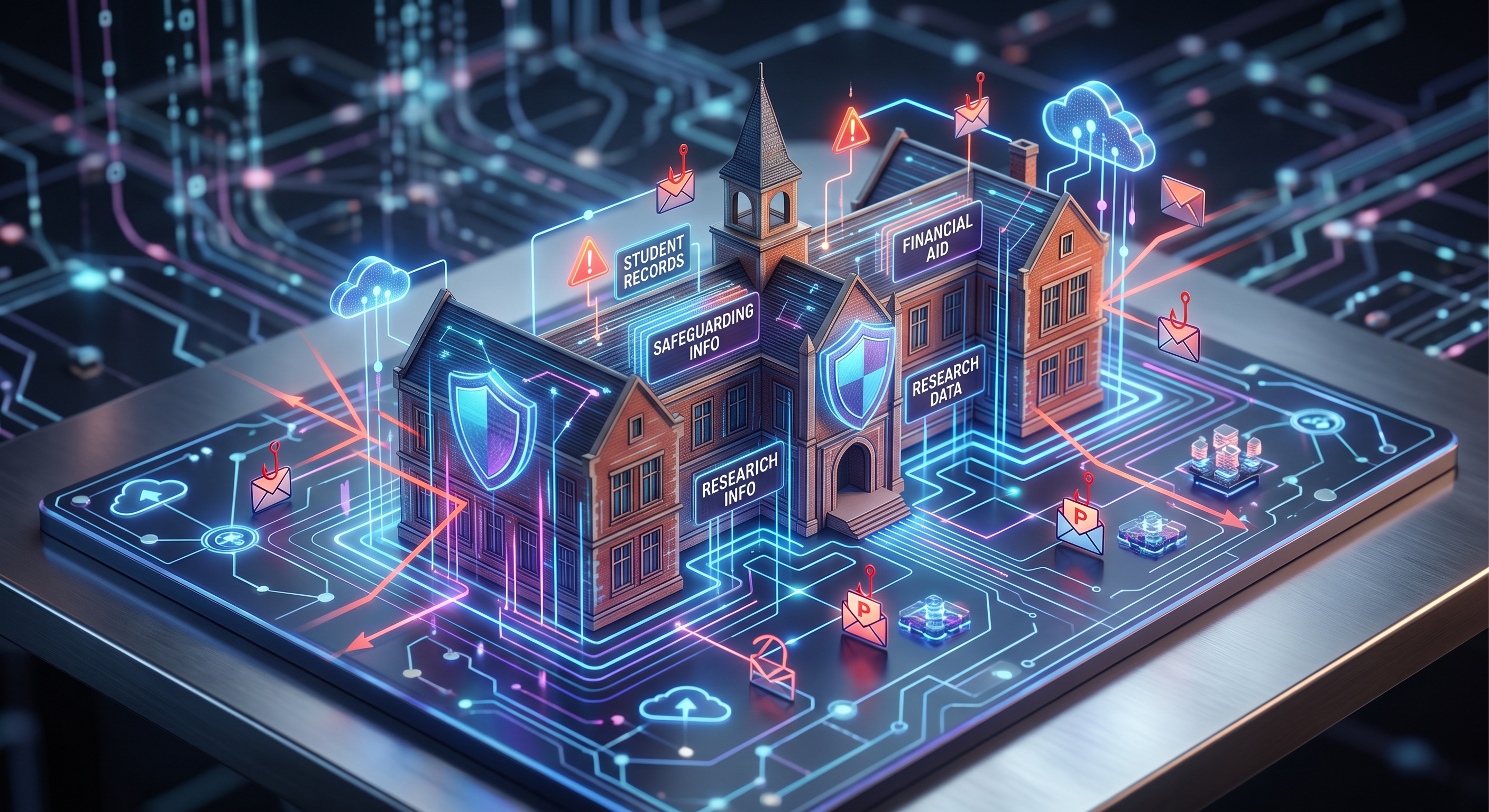
Valuable, varied data. Institutions hold student records, health and safeguarding information, financial aid details, staff payroll data, and, for universities, high-value research. That breadth makes education a target for financially motivated criminals and, in the case of universities working on sensitive research, nation-state actors too.
Large attack surfaces. Most schools rely on dozens of third-party platforms, from learning management systems to payment portals, each representing a potential entry point. Shared logins, ageing devices and high staff turnover only add to the exposure.
Resource constraints. Security budgets and specialist staffing in education typically lag far behind other sectors, even though the threat level is higher. Patch management, one of the more basic technical controls, remains one of the weakest areas across the sector.
Phishing dominance. The overwhelming majority of attacks still start the same way, through phishing. Around 9 in 10 primary and secondary schools that experienced a breach say phishing was involved. It's a reminder that a lot of institutional risk comes down to a single click.
The cost isn't just financial
When an attack succeeds, the fallout tends to be broader in education than in most sectors. Beyond direct financial cost, which can run into millions for a serious ransomware incident, institutions report lost teaching time, damaged trust with parents and students, and long recovery periods for IT systems that weren't built with rapid restoration in mind.
What this means for organisations working with the sector
Education isn't an isolated ecosystem. Suppliers, local authorities, exam boards, edtech providers and public bodies all connect into it, which means the sector's weak points can become everyone else's problem too. A few practical takeaways for any organisation that touches education data or infrastructure:
- Treat third-party and supply chain risk as a priority, not an afterthought. If your business supplies services to schools, colleges or universities, your security posture becomes part of theirs.
- Assume phishing will get through eventually, and build detection and response around that assumption rather than relying on prevention alone.
- Review contracts and data-sharing agreements with education partners to understand exactly what data is shared, how it's protected, and what happens if something goes wrong.
The pattern across the last few years is consistent: attacks on education are increasing in frequency and severity, while the resources available to defend against them often aren't keeping pace. For any organisation connected to the sector, that gap is worth taking seriously now rather than after the next headline.
Want to hear more from experts tackling issues like this? Inspired Business Media summits bringing together industry leaders to discuss the challenges facing businesses today, cyber security included. Keep an eye on our events to find out more.



.JPG)
.png)
