
Nasstar's Chris Halbard on Growth, AI and the Human Side of Transformation
Chris Halbard doesn't do steady state. Across a career spent leading global organisations through change, he has consistently gravitated toward businesses that need to accelerate or need to survive. So when he joined Nasstar as Group CEO, it wasn't the comfort of an established platform that drew him in, it was the scale of the opportunity still sitting untapped beneath the surface.
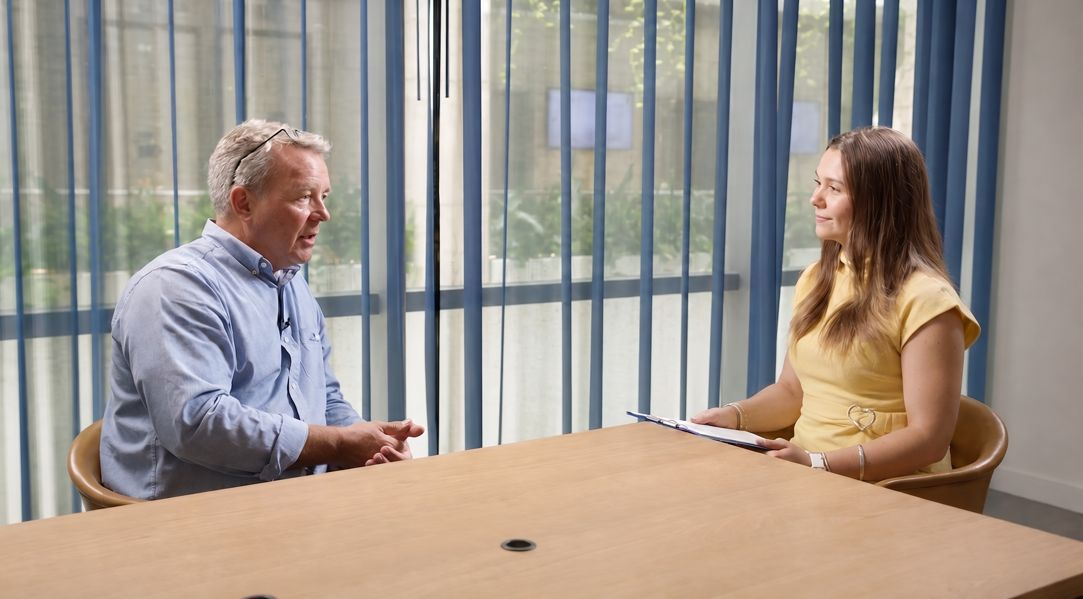
Five months into the role, Halbard sat down with Poppy Goggin-Jones to talk about what he's found inside the business, how he thinks about Nasstar's proposition to the market, and why he believes most failed AI investments have nothing to do with the technology at all.
What was it about Nasstar's positioning that made it the right move for your next chapter?
"I'll give you the answer today, rather than the answer when I first joined, thankfully, they're both the same," Halbard says. Looking back across his career, he notes that his moves into large organisations have almost always been driven by the presence of change: a business that needs to accelerate, or one that needs to survive.
Nasstar, he says, fit that pattern immediately. "There are a collection of assets here that aren't fully realising their potential. There's a marketplace that's there. I think we can play a role in that marketplace above what we're doing now." A significant part of his role, he explains, is painting that picture for the leadership team, building their confidence to take calculated risks and stay relevant in the market. The foundational work, he adds, has already been done: "The business did get off track. It's now back on the tracks, but we're not at full speed. So it's really just moving the business forward."
Having had time to look beneath the surface, what has impressed you most, and where do you see the biggest opportunities for growth?
Halbard is candid about his process. "There are a few stones I've turned over that I shouldn't have done, that always happens," he laughs, before describing nearly five months spent talking to customers and colleagues and, above all, listening. "Two ears and one mouth works really well in these types of situations."
What he's found is a business with genuine strengths: technically capable people who are focused on customers and on doing the right thing, and a client base spanning from emerging financial institutions to public sector authorities. He points to concrete proof points, helping clients build the data foundations that make AI viable ("without good data, you don't have good AI, and lots of AI is failing because of that"), delivering secure connectivity as remote and hybrid working expand the number of endpoints businesses need to protect, and rolling out productivity tools like Copilot and other agentic solutions.
The opportunity, as he sees it, is consistency. "The challenge is an old saying: rinse and repeat. If we can do more of the good things and less of the bad things, not only will we be more relevant in the market, but we will grow." And growth, he adds, is self-reinforcing: "It'll give great opportunities for people in the business, because we must feel a bit better working for a business that's growing and creating great outcomes for clients. Confidence breeds growth."
Nasstar brings together secure connectivity, cloud applications, data and specialised engineering. How do you package those distinct pillars into one unified proposition?
Here Halbard offers what he calls a slightly controversial answer: he doesn't think there should be one single value proposition at all. "It's one journey," he explains. Every business, he argues, is on a path toward using data to create more insight and exceed customer expectations, whatever label gets attached to it, AI, automation or agentic.
That journey requires secure movement of data across an increasingly hybrid, interconnected environment, which is where connectivity becomes foundational. From there, understanding how people actually interact with tools like Microsoft 365 and Copilot shapes the process changes that make AI relevant. And for clients further along, say, a private equity firm that has merged five companies with five different systems, data engineering can deliver insight immediately, rather than waiting 18 months to consolidate onto a single platform.
"Different clients are at different points," Halbard says. Some need secure networks and remote access first. Others have that under control and want to build more collaborative ways of working. Others still have plenty of data but aren't extracting timely insight from it. "I look at it as a journey with on-ramps and off-ramps," he says, "and we can cover probably the three biggest areas of on- and off-ramps as everybody goes on that journey."
He reaches for an analogy from a famous Danish toy company: take a handful of standard bricks in different colours, arrange them differently, and you build exactly what a particular child, or in this case, client, needs. "Using standard building blocks to create a bespoke service that will exceed that client's expectations… I don't think it's one offer to one client. I think it's multiple building blocks."
Does that perspective give Nasstar something unique in how it presents itself to the market?
"I think it's a big asset," Halbard says, though he's careful with the word unique. "There's always someone out there who does something similar." What he does believe sets Nasstar apart is the breadth of skill across the entire journey, both technically and in consultative selling, paired with people who've lived through these transformations with clients before and bring real-world experience to the table. "I think part of our role is putting the right people in front of the right question at the right time."
You've led major operational transformations throughout your career. What separates transformation that creates genuine value from transformation that just creates noise?
Two things, Halbard says without hesitation. First, absolute clarity of goal, tied to the business strategy and a clear sense of the outcome being pursued. Second, and the one he sees overlooked most often, communication. "Comms, comms, comms, comms, comms. Communicate, communicate, communicate."
Transformation, he stresses, is never a smooth climb. "It will have bumps. It will take longer than you think. At times you'll go off track, and you've got to come back on." That's why governance and openness matter so much throughout the process: are people comfortable being candid? Do they understand what's happening and why?
He's equally clear that not everyone will come along for the ride, and that's a legitimate outcome, provided the communication has been honest. "I can't carry passengers on a transformation, but at least you've communicated everything." What he won't accept is people being asked to form judgements without the full picture. "I don't think that's fair on either side."
Crucially, Halbard doesn't see himself as the source of the answers. "I do not have all the answers. A large part of my role is to put in place an environment where those answers, from the experience of the whole team, come to the surface, get respected, and get implemented." In his experience, the best answers in a transformation rarely come from external consultants or the C-suite. "The C-suite sets the strategy and the outcome, but how to execute, generally the answers are within the business."
Change inevitably brings pushback. How do you deal with that?
Pushback, Halbard says, is not just common, it's universal. "You can't change a business without changing the mindsets of people to want to make that change." Skipping that step risks a transformation that doesn't stick, one the business ends up having to reignite months later.
He offers a sharp example rooted in AI itself: think about the person in every organisation who has traditionally been "the oracle", the one who's been there longest, who knows how everything really works, who everyone goes to for answers. An AI transformation, by design, surfaces that insight for everyone instantly. "That person, the Oracle, is that person going to like change? Maybe not. But is that person someone who can really help you on that change journey, because they know how it works today? Absolutely." The lesson, he says, is that the pitch to that individual needs to look different from the pitch to everyone else, because change touches people's sense of their own value differently depending on where they sit.
His broader read on disagreement is unusually generous. "I subscribe to a simple view that no one comes to work to make a mess, no one comes to work to make a mistake." When someone pushes back, Halbard's instinct is to ask whether they've been given the full context, and to treat the exchange not as conflict but as a search for a better answer. "Are we disagreeing, or are we finding a better answer?" Either the business moves to a better position because of new context, or it stays where it started with broader buy-in and understanding. Either way, he argues, the outcome improves.
The exception is disagreement without substance, people who object simply because they'd prefer another way, without being able to articulate why. There, Halbard's approach is pragmatic: move forward with a rationale the wider business can understand and rally behind. "If we get it wrong, better we get it wrong quickly and fix it than keep arguing about something we cannot articulate why."
What are the most important priorities for Nasstar over the next two to three years, and what would meaningful success look like?
The throughline, Halbard says, is relevance, to more customers, translated directly into growth. Parts of the business are already growing healthily; others aren't, and the business overall has declined over the past couple of years. "But I think we're at a point where we're turning now."
Success, in his framing, is straightforward: staying part of clients' journeys, whether that's connectivity, applications, workforce productivity, data engineering or AI, and consistently meeting or exceeding the expectations set with them. Growth, in turn, creates opportunity for Nasstar's own people, many of whom will need new skills as parts of their current roles become automated. "That's commodity now. Hard work, but it is," he says of the shift.
His deeper point is about where Nasstar's expertise should really sit. "The fact that we provide technology and IT services and connectivity services and data engineering services makes it sound as though we should lead with technology. We shouldn't. We should lead by understanding the business model of our clients, what they're trying to achieve, and then work out with them how to help them accelerate to their goal." Technology, in his view, is simply the tool. "If we do that, we'll sell more tech and services anyway, because we're more relevant to those customers."
Many business leaders feel intense pressure to invest in AI, yet most enterprise deployments fail to show clear ROI. What non-negotiable questions should leadership teams ask before committing capital?
Halbard draws on experience from his last few roles, including this one, to offer two core principles. The first is to remove the question of whether to adopt AI from the table entirely. "Let's get past this choice issue. We're doing this. Now let's be very clear on how and where, and what outcome we're looking for." Are you automating billing? Proposal production? Onboarding? What insight are you actually trying to extract from the data you hold? Clarity on the starting point, he argues, is non-negotiable.
The second, and, in his experience, the harder one, is understanding the sheer scale of organisational change AI adoption demands. "I believe a lot of AI pilots, or starts, are failing not because of technology. Technology is brilliant; it's there." The real barrier is the process and people: retraining staff, helping them understand that skills they once considered core are no longer their differentiator, and building genuine buy-in.
"The AI won't fail for technology; it will fail because people don't use it, or people don't see how it can add value." An evangelist at the top of the organisation can set the direction, Halbard says, but execution depends on the whole business understanding, and working through, the change involved. "You've got to invest in people, comms and process change. The technology gives you the opportunity to go. Without the people, you won't go."


.JPG)
.png)
